

When FPGAs do not implement a multiplier HW macro
Modern
FPGAs implement multiplication using a dedicated hardware resource. Such
dedicated hardware resource generally implements 18×18 multiply and accumulate function.
Many FPGAs use two 9×9 multiplier IP to implement a single 18×18 multiplier
macro. It depends on the technology you are using.
Depending on the technology and FPGA you are using it is also possible to have no multiplier at all as dedicated IP. In this case, if you need to perform a multiplication it could be a problem. Multiplication is a very demanding operator in terms of area and timing resources, so you need to pay attention to the operand number of bits in order to minimize the area and timing impact on your FPGA.
There are
some particular cases in which it is possible to optimize the multiplier number of
bits.
In this
post I want to address an example you can use as guideline for multiplier
optimization.
Sine and Cosine quantization
A typical
example where we can optimize the number of bits of a multiplier is when one of
the two operands is the quantization of sine and cosine.
DISCLAIMER: this is a particular case; it cannot be applied to all multiplications. This optimization only works when one operand is close to its maximum value (e.g., cosine near 0°).
The assumption is that we need to perform a multiplication like that:
M1 = op1 * sin(a)                      EQ1
M2 = op2 * cos(a)
Op1 and op2 quantized with N bit, sin(a), cos(a) quantized using K bits.
There is a very particular case where the angle “a” takes ONLY values on a restricted range, for instance, +/- 10°
In this
case, cos(a) needs all the K bits but sin(a) needs few bits. Let’s give a
practical example with K=8
Sin(-/+10°) = -/+ 0.1736
Cos(-/+10°) = 0.9848
Using 8 bit
we have the quantized values:
round(127*Sin(+10°)) = +22
round(128*Sin(-10°)) = -22
round(128*Cos(-/+10°)) = 126
clearly,
even using 8 bits, for sine quantization the number of bits we really need is
only 6 instead of 8, since using 6 bits we can range [-32..+31].
For cosine
we have a problem. We need to use all the 8 bits!
Optimizing the cosine quantization
We realized
that sine quantization ranges in [-22 .. + 22] so we need 6 bits but cosine
quantization needs all the 8 bits.
As you know
any number can be written as this equation:
C = (C-1) + 1 EQ2
We will not win the Nobel prize for this equation, but it is useful for cosine quantization. Using Eq2 we can rewrite the cosine value as follows:
Cos(-/+10°) = (cos(-/+10) -1) + 1 =        EQ3
(0.9848 – 1) + 1 = -0.0152 + 1
If we quantize the EQ2 we have:
round(128*(Cos(-/+10°)-1)
+ 128 = -2 +128
As is clear,
for cosine quantization we need a number of bits much less than 8
In practice, -2 fits in 3 bits (110 in 2’s complement) while 126 requires 8 bits (01111110). The optimization saves 5 bits for the cosine operand.
Multiplier Bit-Width Optimizer
0.0°VHDL implementation of multiplier optimization
The multiplications in EQ1 can be implemented in VHDL as follows.
library ieee;
use ieee.std_logic_1164.all;
use ieee.numeric_std.all;

entity mult is
port (
    i_clk           : in  std_logic;
    i_rstb          : in  std_logic;
    i_sin           : in  std_logic_vector( 5 downto 0); -- +/-10° 8 bit quantization
    i_cos           : in  std_logic_vector( 3 downto 0);
    i_op1           : in  std_logic_vector( 7 downto 0);
    i_op2           : in  std_logic_vector( 7 downto 0);
    o_m1            : out std_logic_vector(15 downto 0);  -- 8+8 bit output
    o_m2            : out std_logic_vector(15 downto 0));
end mult;

architecture rtl of mult is
-- used to implement left shift for op2
constant C_ZERO_FILL   : std_logic_vector(6 downto 0):=(others=>'0');
signal r_op2           : signed(i_op2'length+C_ZERO_FILL'length-1 downto 0);
signal r_sin           : signed(i_op1'length-1 downto 0);
signal r_cos           : signed(i_op2'length-1 downto 0);
signal r_m1            : signed(i_op1'length*2-1 downto 0);
signal r_m2            : signed(i_op2'length*2-1 downto 0);


begin

p_input : process (i_rstb,i_clk)
begin
    if(i_rstb='0') then
        r_op2           <= (others=>'0');
        r_sin           <= (others=>'0');
        r_cos           <= (others=>'0');
        r_m1            <= (others=>'0');
        r_m2            <= (others=>'0');
        o_m1            <= (others=>'0');
        o_m2            <= (others=>'0');
    elsif(rising_edge(i_clk)) then
        -- multiply by 2^7
        r_op2           <= signed(i_op2&C_ZERO_FILL);
    -- sign extension
        r_sin           <= resize(signed(i_sin),i_op1'length);
        r_cos           <= resize(signed(i_cos),i_op2'length);
        r_m1            <= r_sin * signed(i_op1);
        r_m2            <= r_cos * signed(i_op2);
        o_m1            <= std_logic_vector(r_m1);
        o_m2            <= std_logic_vector(r_m2 + r_op2);
    end if;
end process p_input;

end rtl;
In the VHDL code for the multiplier, the value of the cosine multiplied by 128 is simply left shifted by 7 bits. As you know, a multiplication by power of two can be implemented as a left shift by N where N is the value of the exponent.
Simulation of VHDL implementation of multiplier optimization
The
simulation below shows the value of the multiplication of
op1*sin(10°)
op2*cos(10°)
where the
second multiplication is implemented using the optimization presented in the previous
section.
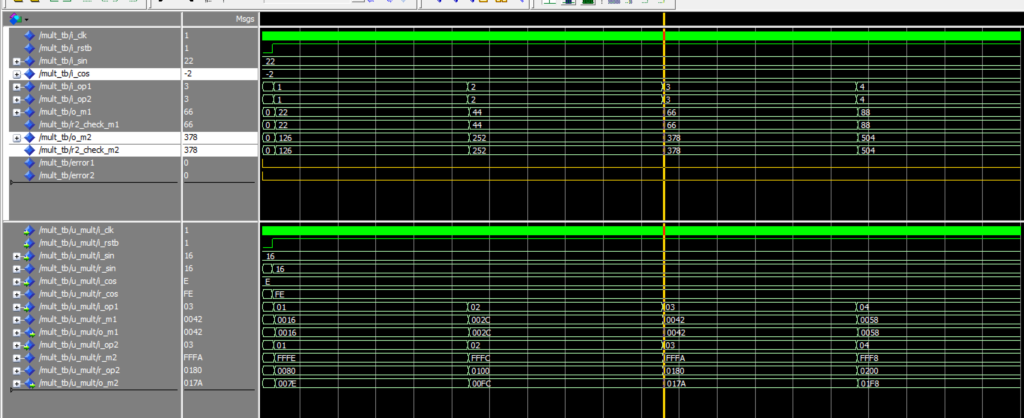
Optimized VHDL multiplier simulation results
In this
case the value passed to the VHDL code for the cos(10°) is not the quantization
of
Round(128*Cos(10°))
= round(128*0.9848) = 126
But the value
round(128*(Cos(-/+10°)-1)
= -2
the error
signals are relative to the comparison of the output results of the VHDL code above
vs the classical multiplication
op2*cos(10°)
= op2*126
as is clear,
the output relative to the multiplication performed with the optimized VHDL matches
with the value performed with the classical multiplication.
Conclusion
In this post, we addressed a possible optimization that can be adopted in a multiplier when the multiplier operand value is close to the maximum value. A typical example is the cosine value when the angle is on the range of +/- 10°
In this case, we don’t need to use all the number of bits to represent the cosine value, but we can take advantage of the equation:
Cos(a) = (cos(a)-1)+1