

VHDL multiple conditional statement
In this post, we have introduced the conditional statement. The IF-THEN-ELSE is a VHDL statement that allows implementing a choice between different options. When the number of options is greater than two we can use the VHDL “ELSIF” clause. In the case of multiple options, VHDL provides a more powerful statement in both the concurrent and sequential versions:
- CASE-WHEN sequential statement
- WITH-SELECT concurrent statement
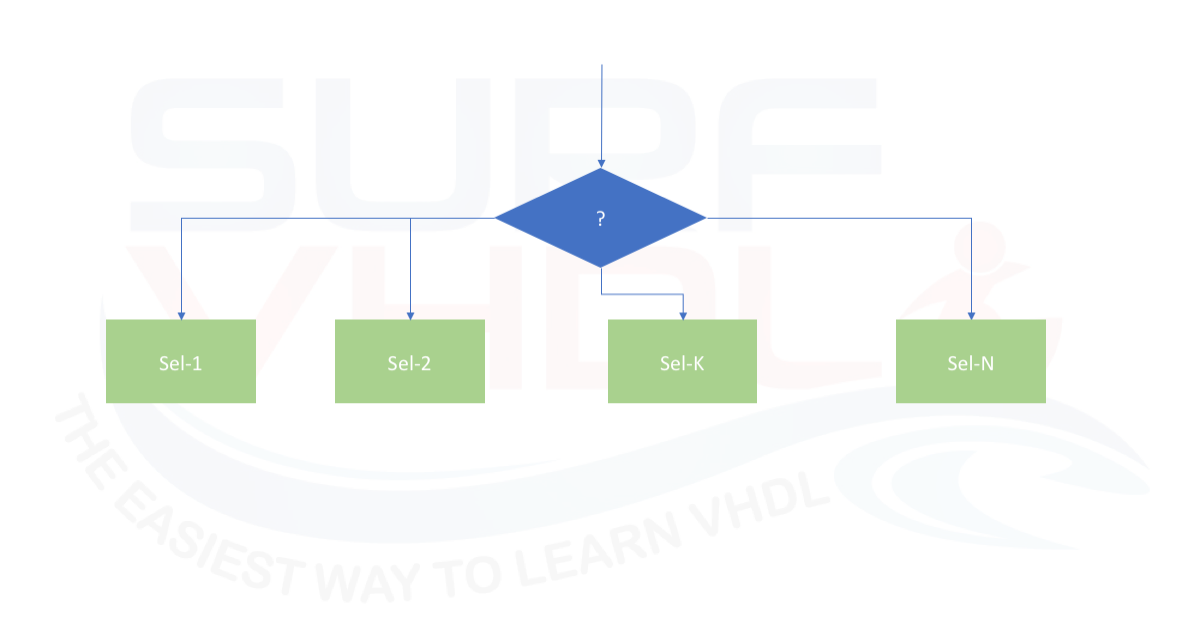
Figure 1 – Multiple conditional statement visual representation
VHDL CASE and WITH-SELECT statement syntax
The BNF of the multiple VHDL conditional statement is reported below.
VHDL sequential CASE-WHEN statement BNF and example is:
case_statement ::=
  case expression is
    case_statement_alternative
    { case_statement_alternative }
  end case ;

case_statement_alternative ::=
  when choices =>

sequence_of_statements choices ::= choice { | choice }

choice ::= simple_expression
  | discrete_range
  | element_simple_name | others


EXAMPLE:

case element_colour of
  when red                 => statements for red;
  when green | blue        => statements for green or blue;
  when orange to turquoise => statements for these colours;
end case;

case opcode of
  when X"00" => perform_add;
  when X"01" => perform_subtract;
  when others => signal_illegal_opcode;
end case;
VHDL concurrent WITH-SELECT statement BNF and example is:
with expression select
  s <= waveform_1 when choice_list_1,
     waveform_2 when choice_list_2,
     ...
     waveform_n when choice_list_n;


with alu_function select
  alu_result <= op1 + op2   when alu_add | alu_incr,
                  op1 – op2   when alu_subtract,
                  op1 and op2 when alu_and,
                  op1 or op2  when alu_or,
                  op1 and not op2 when alu_mask;
IF-THEN-ELSIF vs CASE statement
The considerations we are doing on the IF-THEN-ELSIF and CASE-WHEN sequential statement can be applied also to the concurrent version of the conditional statement. The sequential CASE-WHEN statement is more adopted in the common VHDL RTL coding for conditional statement with multiple options. It is more similar to the normal programming code approach even if the hardware implementation must be taken into account as parallel processing.
The IF-THEN-ELSIF statement implements priority on the choice selection, which comes directly from its syntactic meaning.
When we use the CASE-WHEN statement no priority is implemented in the code and as consequence on the hardware instantiated. When using CASE-WHEN, it is recommended to include a when others clause to cover all remaining choices and avoid unintended latch inference.
Here below we can see the same implementation of a 4-way mux using the IF-THEN-ELSIF and the CASE-WHEN statement.
library ieee ;
use ieee.std_logic_1164.all;


entity mux4_if is
port(
  a     : in  std_logic_vector(3 downto 0);
  b     : in  std_logic_vector(3 downto 0);
  c     : in  std_logic_vector(3 downto 0);
  d     : in  std_logic_vector(3 downto 0);
  s     : in  std_logic_vector(1 downto 0);
  m     : out std_logic_vector(3 downto 0));
end mux4_if;

architecture rtl of mux4_if is
begin
  p_mux : process(a,b,c,d,s)
  begin
    if   (s = "00") then m <= a;
    elsif(s = "01") then m <= b;
    elsif(s = "10") then m <= c;
    else  m <= d;
    end if;
  end process p_mux;
end rtl;
VHDL code of 4-way mux using the sequential statement “if-then-elsif”
library ieee ;
use ieee.std_logic_1164.all;


entity mux4_case is
port(
  a     : in  std_logic_vector(3 downto 0);
  b     : in  std_logic_vector(3 downto 0);
  c     : in  std_logic_vector(3 downto 0);
  d     : in  std_logic_vector(3 downto 0);
  s     : in  std_logic_vector(1 downto 0);
  m     : out std_logic_vector(3 downto 0));
end mux4_case;

architecture rtl of mux4_case is
begin
  p_mux : process(a,b,c,d,s)
  begin
    case s is
      when "00"   => m <= a;
      when "01"   => m <= b;
      when "10"   => m <= c;
      when others => m <= d;
    end case;
  end process p_mux;
end rtl;
VHDL code of 4-way mux using the sequential statement “case-when”
As clear from the RTL viewer in Figure2, the VHDL code of the 4-way mux is translated into two different VHDL-RTL implementations. In Figure2 on the left is reported the RTL view of the 4-way mux implemented using the IF-THEN-ELSIF VHDL coding style. A set of comparators are used to select the cascaded 2-way mux as described in the VHDL code. On the right is reported the straight forward 4-way mux implementation as described by the CASE-WHEN VHDL coding style.
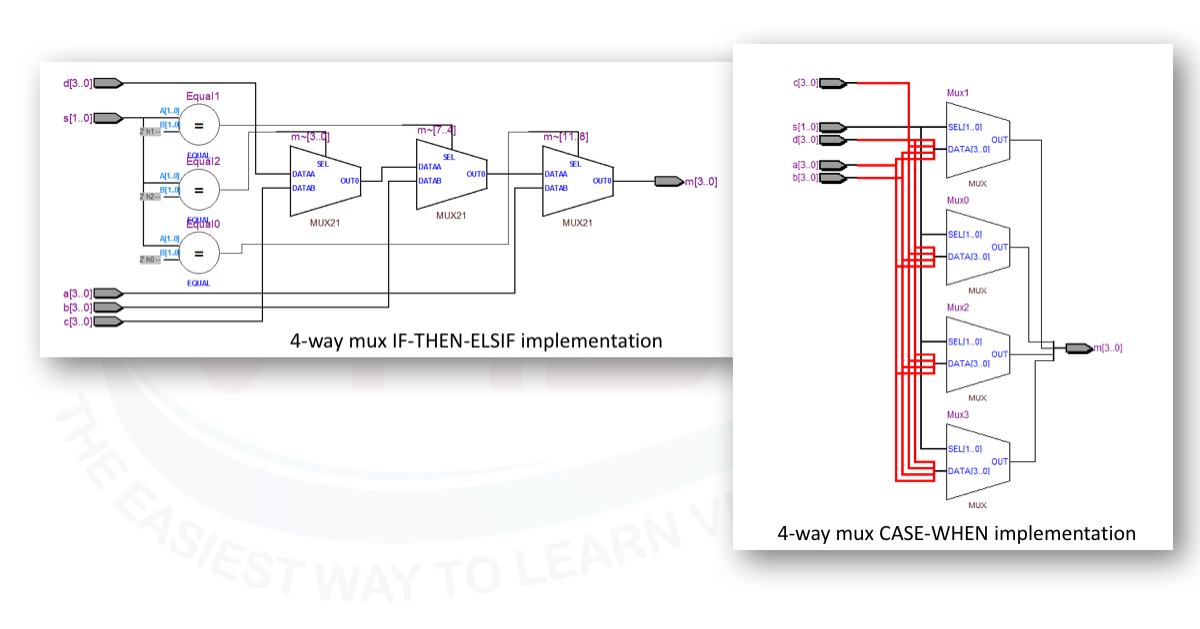
Figure 2 – RTL viewer 4-way MUX with different VHDL coding approach
Now we need a step forward. Looking at Figure 3 it is clear that the final hardware implementation is the same.
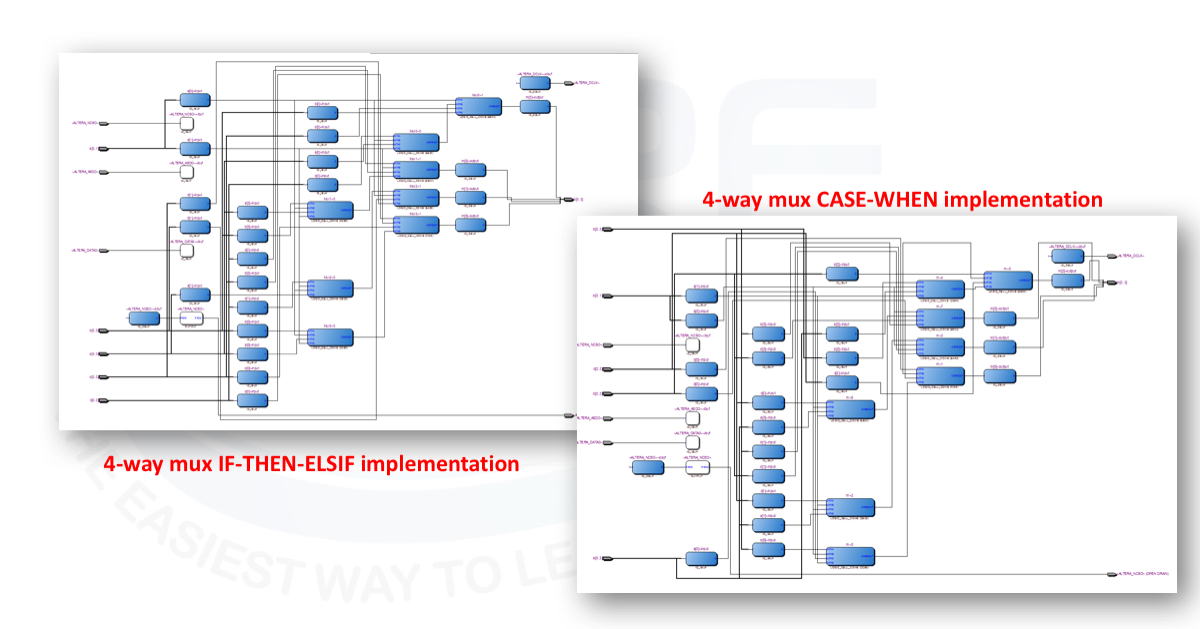
Figure 3 – Technology viewer 4-way MUX with different VHDL coding approach
Different RTL views can be translated in the same hardware structure!
wait, wait… different RTL implementation can be translated in the same hardware circuit?
Yes!
As I always say to every guy that contact me,
you must think hardware!
Think about it: even if you are writing a VHDL code using IF-THEN-ELSIF statement, the final output comes from a 4-way mux. The logic synthesizer does its work simplifying the Boolean equations that come from your VHDL-RTL coding giving as result the 4-way mux we want to implement.
Conclusion
Every time we write a VHDL code to implement some hardware circuit, we need to pay attention to which VHDL instruction or construct is better to use.
As a rule of thumb, the selection of the RTL architecture should be guided by the similarity of VHDL-RTL code to the final hardware.
A very good practice is also to verify the RTL viewer implementation and eventually, the final technology implementation both on the output reports and the technology viewer.
Reference
[1] RTL HARDWARE DESIGN USING VHDL Coding for Efficiency, Portability, and Scalability
[2] VHDL Programming by Example 4th Ed Douglas – Perry